










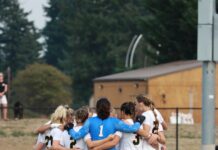



For all purposes of transparency, honesty and integrity, I am a lacrosse player on the women’s lacrosse team at PLU.
From America’s pastime to Sunday night football, and even more recently the growing popularity of women’s professional athletics, sports play a significant role in American life. However, some of America’s oldest sports don’t often get attention or remain unknown to all but the creators of the game.
America was built on indigenous land. For Indigenous people, sports are more than just a game – they often have spiritual connections or are ways to resolve conflicts. Sports are more than a competition but rather “for Indigenous communities sports and spirituality intertwined,” said Suzanne Crawford O’Brien, professor of religion and culture at PLU.
Lacrosse, for example, originated from the Haudenosaunee, according to the Haudenosaunee Confederacy, which is made up of the Mohawk, Oneida, Onondaga, Cayuga and Seneca people. Lacrosse is known as the Creator’s Game or a medicine game. The sport is a gift from the creators and is used to strengthen and heal the sick. The sport is also used as a way to settle disputes, a way of peacemaking.
The Haudenosaunee Nationals, the professional Haudenosaunee lacrosse team, has faced many barriers on an international level. The sport has been introduced again to the Olympic stage for the first time since 1948. However, the Olympic committee will not permit the Haudenosaunee people from playing under their own name during the 2028 Summer Games despite support from both the United States and Canadian Olympic committee. The Haudenosaunee people have been able to compete under their own name on an international level for years. They are a member of World Lacrosse , a recognized organization by the International Olympic Committee. According to the Onondaga Nation, in 2022 the Haudenosaunee Nationals qualified to compete in the World Lacrosse championship but at first were denied eligibility because they did not have a National Olympic committee, one of the barriers preventing them from competing in the 2028 Olympic games.
PLU has both a varsity and club team and it is important to honor and respect the roots of the game. A few of the ways to honor the game are by athletes celebrating the history of the game, celebrating the Indigenous players, and advocating for those who started the game. They can also share and educate others on the history of the game. Despite lacrosse being a Haudenosaunee sport, according to the NCAA, less than 1% of all NCAA lacrosse players are Native American or Alaska Native. Lacrosse in the modern time has been taken over by a predominantly white majority; in the same consensus by the NCAA, 55% of all NCAA lacrosse players are white.
While lacrosse is a traditional Indigenous sport, nontraditional sports like basketball have become sacred to many. “Basketball’s a really interesting one in a lot of communities too, where it becomes this really unifying force,” O’Brien said. Basketball was introduced in a very traumatic way by forcing Indigenous people to play non-Indigenous sports and later it was reclaimed and “being sort of indigenized, it becomes their version of basketball,” shared O’Brien. Despite basketball not being a traditional sport, it still plays a similar role to those sports that are. It helps cultivate community and celebrates identity.
Sports serve as a way to bring communities together. Athletics are so much more than they seem. They play roles in “bringing the community together, investing, revitalizing cultural identity, pride, and bringing health and wellness all into the same kind of place,” O’Brien shared.