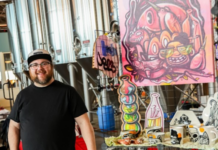








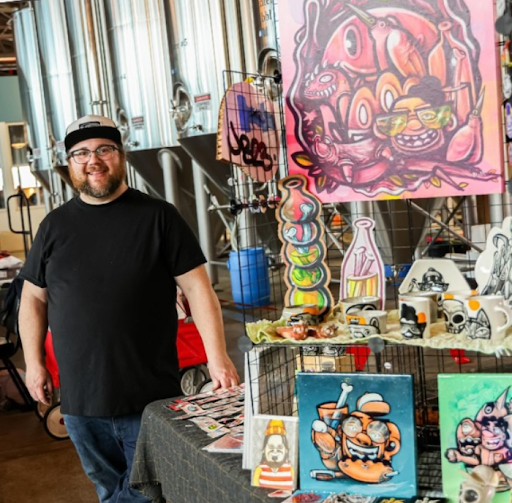
Tacoma-based artist Joseph Brooks is used to working in public spaces where art meets everyday life. With a practice that spans murals, painting, and ceramics, Brooks is known for bold linework and stylized figures that feel grounded in place. Now, he’s bringing that perspective to Parkland as one of six finalists selected for Parkland With Purpose, a new mural project taking shape along Pacific Avenue.
Along one of Parkland’s busiest roads, Parkland With Purpose aims to transform ordinary structures into sites of community expression. The project is a collaboration with Blue Zones Project Parkland-Spanaway, focused on increasing pride, encouraging movement, and fostering a sense of belonging through public art. After reviewing submissions from artists with roots in the Tacoma–Pierce County area, organizers selected finalists whose work reflects both personal ties to the region and a responsiveness to Parkland’s identity and daily flow.
Brooks said the Parkland With Purpose project stood out to him for both practical and personal reasons. He learned about the opportunity through Tacoma Spaceworks, an organization he has previously worked with, and was drawn to the location and mission. “I had just done a mural… and I was like, ‘Oh, it’d be fun to be in that neighborhood again,’” he said. With family ties to the area and familiarity with the South Sound, the project felt close to home.
He was also interested in the goals of Blue Zones Project Parkland-Spanaway, which focuses on healthy living and encouraging people to move through their communities in more connected ways. Brooks noted that Parkland, like many urban areas, is divided by major roadways. “It’s bifurcated with a state route right through the middle of it,” he said. “So it makes it tough to connect. It’s nice to have projects like this bringing awareness to movement and connection beyond just cars.”
As a local artist, Brooks sees public art as both representation and opportunity. “The more projects that are out there for artists, the more viable it becomes for young people who have a vision to go that way,” he said. He added that mural projects have become an important source of support for artists and help keep creative work embedded within the community.
Brooks tends to focus his public art practice within the Puget Sound region, a choice he says is rooted in familiarity rather than limitation. “I know what this region is,” he said. “I’ve lived here my whole life. I know the people. I know the flora and fauna innately.” That knowledge allows him to respond to places without needing extensive research, grounding his work in lived experience.
When Brooks learned he had been selected as a finalist, his reaction was simple: “I was happy,” he said. He laughed while describing the physical challenges of the walls themselves, rough concrete surfaces, but emphasized the opportunity the location provides. “The visibility is really great,” he said. “Hopefully, it’ll put some smiles on faces as people drive by. Pacific [Avenue] can be pretty stressful.”
Balancing personal style with community expectations is something Brooks approaches with intention. “Public art is different,” he said. “It’s not necessarily just for me. It’s really for the community.” He explained that while his artistic voice will naturally be present, the goal is to listen closely and avoid repeating the kind of sanitized narratives that have often defined older community murals. “I don’t want to continue that,” he said. “I’m just a hand in it.”
Looking ahead, Brooks hopes the mural’s impact is felt in small but meaningful ways. “If one person can look over it and smile where they weren’t smiling, that’s huge,” he said. He believes those moments can ripple outward, shaping how people experience shared space over time. “Ultimately, I just want people to be happy,” Brooks said. “Happy as a community, not just as individuals.”