
















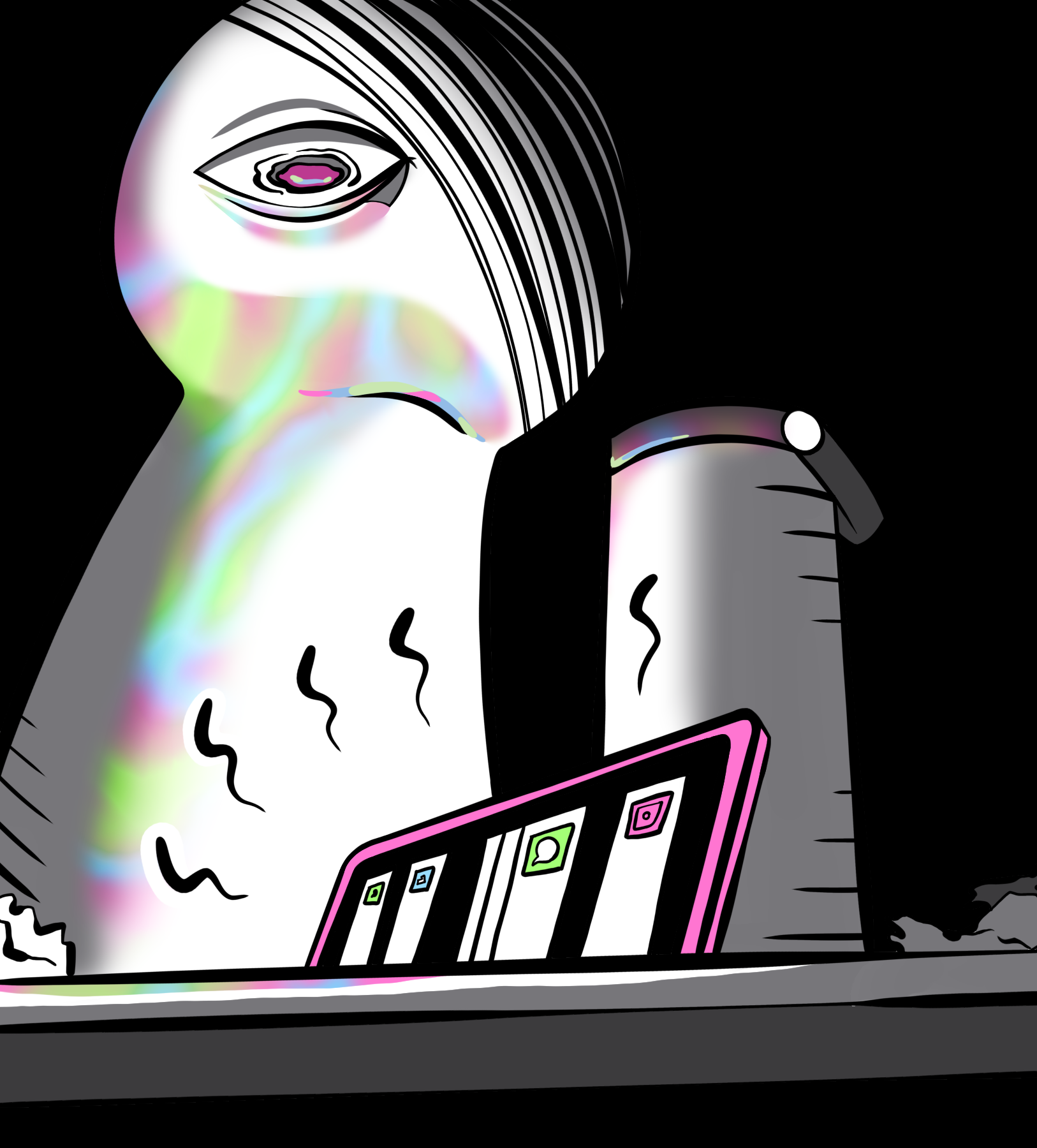
The soft blue glow of your smartphone screen shining in your face early in the morning and late at night is probably something you’ve grown very accustomed to. Your smartphone is one of the greatest tools of the twenty-first century—it’s a phone, a camera, a journal, an encyclopedia, a computer, a calculator, and so much more. With the creation of social media, it is also one of our greatest forms of entertainment, skyrocketing our generation’s screentime. Smartphones can be fun, but they also have the ability to become an addiction with very negative consequences when overused.
It’s easy to spend hours scrolling online, without even noticing how long it’s been since you put the phone down for some wind-down time. Smartphones are designed to be addictive. The bright colors of apps, notification sounds, and phone vibrations are all designed to keep our fingers and eyes on the screen. According to Tristan Harris, a former Google design ethicist, the “pull to refresh” function on many apps was designed with the mechanism of slot machines in mind. It’s no wonder so many of us can’t get off it. Still, being on our phones for too long can have very bad effects on both our mental and physical health, creating sleep deficits, lower concentration, decreased cognition, insecurity, and stress.
Phone addiction is a behavioral addiction, like gambling. In addiction, the pathways of your brain involved in producing important neurotransmitters, such as dopamine, work to reinforce addictive behavior. Dopamine tells the brain that the action that produced dopamine is a good action that should be repeated, that action is then associated with pleasurable feelings. Dr. Tiffany Artime, PLU’s department chair of psychology, describes it as, “Just like if you had a neighbor when you were a kid and you went back and forth between your house and your neighbor’s house, that path would become well-traveled and there wouldn’t be grass there anymore. The same thing happens in your brain. When the path becomes well-traveled, then it becomes very automatic.” These dopamine-worn pathways can create an urge to repeat the addictive behavior, which can be easy to fulfill without thinking.
Some signs you may be addicted to your phone is if your phone use makes it hard to do other things, such as homework, chores, or having a conversation; you feel anxious if you don’t have access to your phone; reading a book or watching a full-length movie has become difficult; or you feel isolated and have a limited social life due to your phone. It may be useful to monitor when you’re reaching for your phone and why. If you go for your phone every time you experience boredom to remove those uncomfortable feelings, it may be time to distance yourself from your screen. It can be ok to use your phone for entertainment, but if it’s to never allow yourself the feeling of boredom or to never be alone with yourself, then it may be a problem. This problem doesn’t have to be hard to fix though. Dr. Artime states, “The amazing thing though, is that you can extinguish that pretty quickly. If you went a week with putting your phone somewhere else or like doing some sort of intervention for yourself where you didn’t have access to that, that habit would very quickly start to be eliminated.”
Getting your life back from this little black rectangle doesn’t have to be difficult, there are many ways to try and cut ties with your phone. Time limits on apps are great at disrupting your brain’s dopamine cycle by making you stop and think about how much time you’re spending on your phone. Physical distance from your phone can also help a lot. You can try keeping your phone in another room or in a drawer when you need to focus. Charging your phone away from your bed can help make sure it’s not the first and last thing you see in a day. Going into settings and limiting or turning off your notifications can help limit the amount of time you pick up your phone. You can also try to remove the “fun” elements from your phone by setting it to black and white. If needed, you can try deleting mobile games and social media to remove all temptations.
Many of us have to use our phones every day, but we can all try to maintain a healthy relationship with our phones. After all, a phone is just another tool. You get to decide how and when you want to use it.