














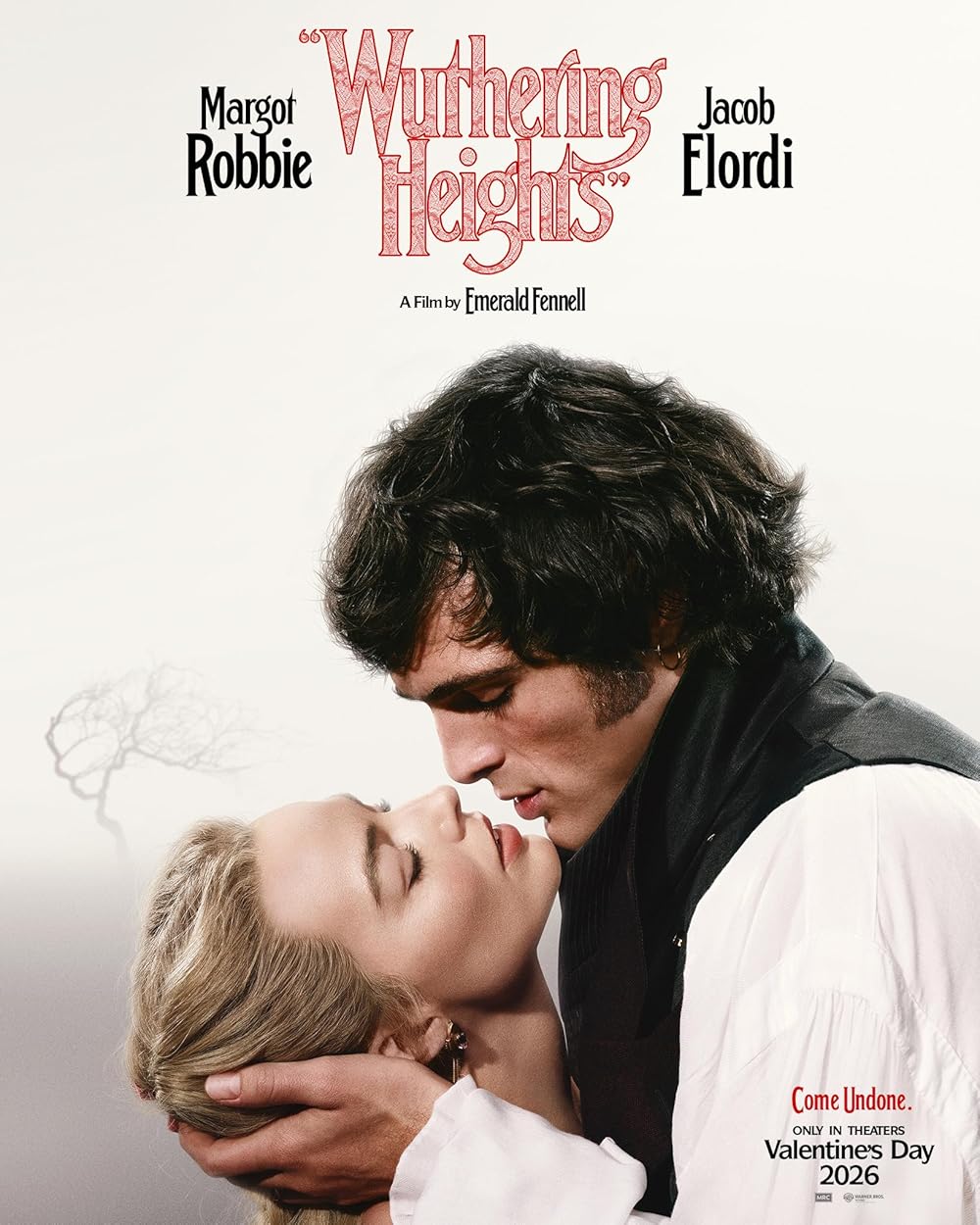
Wuthering Heights is a movie as disinterested in its source material as you are in studying for finals. Emerald Fennel’s 2026 adaptation of Emily Bronte’s 1847 gothic revenge novel has a lot of baggage as both a film and an adaptation. Its cardboard chemistry between the romantic leads, flaccid pacing, and tedious attempts at eroticism outweigh its positives. What’s attracted the most attention about it since the casting announcements, though, is its disloyalty to the book. Fan backlash to any adaptation for being inaccurate may be inevitable. However, it was not inevitable for this movie to racebend characters when adapting a story that centers around oppression.
Heathcliff, the romantic lead of Wuthering Heights, is a person of color. What ethnicity is he? We don’t know. But the book constantly reminds us of his nonwhite status. Our first description of him is as “a dark-skinned g*psy in aspect”, one of the book’s multiple narrators speculates that he might have parents from India and China, and he’s often referred to as a “lascar”, which is a term for Southeast Asian sailors. While Regency era England did have different notions of race than the 21st century USA, they were not a nation unfamiliar with people of color. They were, in fact, used to making a profit off of them. Heathcliff being found in the city of Liverpool, a port town known for its connections with the slave trade, strengthens this connection. And this isn’t an aspect that can be removed from the story without consequence, it is a core theme that Heathcliff’s ethnic otherness causes him to be abused and prevented from establishing a relationship with the main lead, Catherine Earnshaw.
Emerald Fennel casting Jacob Elordi, a white actor, in the role of Heathcliff is sadly nothing new as far as Wuthering Heights adaptations are concerned. What is new is how she does actually include people of color- then proceeds to make them undesirable and villainous. The novel is not a book with many sympathetic characters. That makes the framing of Nelly, one of the few likable characters, as a villainous obstacle to the white leads’ True Love feel insidious when she’s being played by the underutilized Hong Chau.
This racebending habit extends to fly directly in the face of the novel’s social commentary; Edgar Linton, the husband of Catherine Earnshaw, is explicitly stated in the novel to be white and blonde. He embodies wealth and social privilege, everything that Heathcliff aspires to have but is denied. In the film, he’s played by Pakistani-English actor Shazad Latif. As a result, we are left with a movie that sympathizes with a white laborer for glowering at a brown man for his status and romancing a white woman.
Wuthering Heights is not a movie that is ignorant of skin color. It revels in it, fetishizes it. The camera gleefully lingers on Jacob Elordi’s sweaty back, and Edgar Linton even outfits an entire room with walls the color of Catherine’s skin, proclaiming it to be the most beautiful color of all. Yet for all that it celebrates the white skin of its leads, it never has any compassion to spare for anyone outside of its preferred color palette.
However, this isn’t a movie with nothing to appreciate. Emerald Fennel’s cinematography is striking, letting the scenery and set design really shine. Although the costume design is anachronistic, its inaccuracies are done with purpose, to convey character and themes. The child actors in the first act are fantastic, perfectly selling their characters’ dynamics and personalities. This is a movie with an undeniably strong artistic direction, whether that direction appeals to you or not. But all these positives suffer from its many other flaws, making it hard to recommend to newcomers of Wuthering Heights. Its failures as a movie pale in comparison to its failures as an adaptation, though, and so it can’t be recommended to longtime fans either.